AI Will Not Replace You, But… Distraction Might
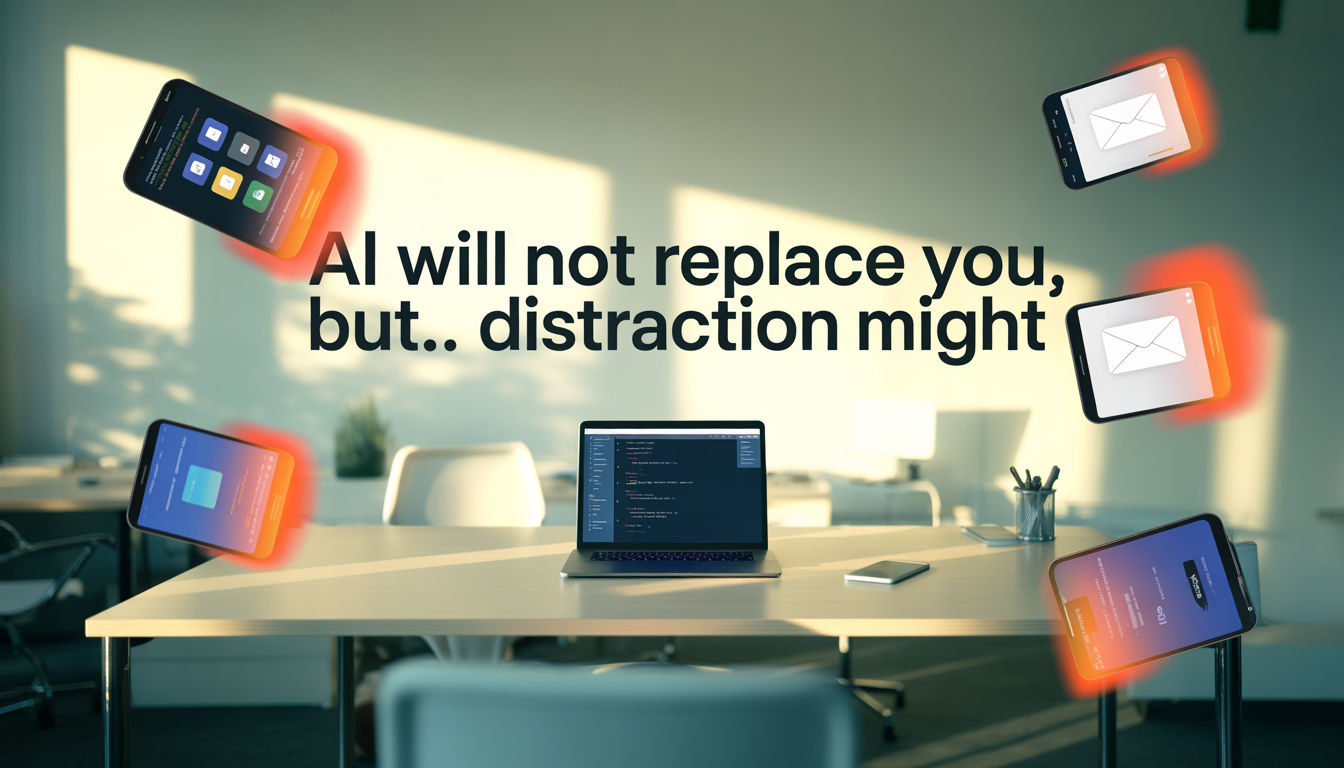 The future of work belongs to focused, aware minds
In the anxious conversations about artificial intelligence replacing human workers, we're missing the more immediate threat to our professional relevance: our fragmenting attention spans.
While we worry about sophisticated algorithms taking our jobs, most of us voluntarily surrender our greatest competitive advantage every day—our ability to think deeply, connect meaningfully, and create originally.
The Hidden Productivity Crisis
The statistics tell a troubling story. The average knowledge worker now checks email or messaging apps every 6 minutes. We switch tasks more than 300 times per day. And according to research from Microsoft, our collective attention span has shrunk from 12 seconds in 2000 to just 8 seconds today—shorter than that of a goldfish.
What's happening isn't just a personal productivity challenge; it's a profound shift in how our minds operate in an environment that profits from capturing and fragmenting our attention.
"The most valuable resource in today's economy isn't AI software or even talent—it's sustained human attention," explains Dr. Maya Richardson, neuroscientist and workplace performance researcher. "And ironically, it's becoming the scarcest."
Your Unfair Advantage: The Focused Mind
While AI excels at processing vast amounts of data and executing defined tasks with remarkable speed, it lacks something uniquely human: conscious awareness and the ability to direct attention with intention.
This distinction matters more than ever. In my work coaching executives across industries facing AI disruption, I've observed a pattern: those who thrive aren't necessarily technical experts, but rather those who have cultivated what I call "attentional intelligence"—the ability to choose where their focus goes and maintain it there despite distraction.
Consider this real-world example: A mid-size marketing firm I consulted with implemented AI tools for content creation, data analysis, and campaign optimization. Initially, team members feared obsolescence. But six months in, an unexpected pattern emerged. The highest performers weren't those most adept with the AI tools, but those who could:
- Frame better questions for the AI to solve (requiring deep understanding of underlying business challenges)
- Evaluate outputs critically (distinguishing between technically correct but strategically misaligned recommendations)
- Synthesize insights across domains that the AI couldn't connect
- Build trust with clients through nuanced understanding of emotional needs that algorithms missed
Each of these capabilities required something increasingly rare: sustained attention and presence.
The Neuroscience of Distraction
Our relationship with distraction isn't just a matter of weak willpower—it's baked into our neurological wiring and exploited by technology design.
The human brain's reward system releases dopamine not just when we discover something new and valuable (an evolutionary advantage), but also when we simply check for potential new information. This creates the perfect conditions for addiction to digital distraction.
"What makes the modern attention crisis particularly challenging," notes Dr. Richardson, "is that we're fighting both our neurological hardware—brains evolved for novelty-seeking—and sophisticated software explicitly designed to hijack our attention."
Each notification creates a momentary attentional "switch cost," requiring up to 23 minutes to fully regain focus on the original task. For many knowledge workers, this means they never enter deep focus at all.
Four Practices for Reclaiming Your Attention
In a world where distraction is the default, focus becomes your superpower. Here are strategies that my most successful clients have implemented:
1. Practice Intentional Digital Boundaries
The leaders with the most cognitive bandwidth aren't necessarily those with superior concentration skills—they're those who proactively structure their environment to require less willpower in the first place.
Try this: Schedule three 50-minute "deep work" blocks weekly. During these sessions, disconnect completely—airplane mode, notifications off, messaging apps closed. Start with just 50 minutes if this feels challenging; you'll be surprised how difficult—and revealing—this exercise can be.
One financial services executive I coached initially claimed this approach wouldn't work in his "always-on" culture. After reluctantly trying it, he discovered that not only did emergencies not materialize during his focus blocks, but his strategic output improved so dramatically that his team began protecting these periods for him.
2. Master the Art of Cognitive Transitions
Each time you switch contexts—between projects, meetings, or even between work and personal life—your brain experiences a transition cost. Most of us manage these transitions poorly, carrying mental residue from previous activities into new ones.
Try this: Create a "mental reset" ritual between significant activities. This might be three conscious breaths, a quick walk around your workspace, or jotting down completion notes from the previous task before beginning the next. The specific ritual matters less than the intentional closure and reopening of attentional space.
3. Develop Regular Mindfulness Practice
Mindfulness isn't just about stress reduction—it's systematic training for your attentional muscles. Research shows that regular meditators demonstrate measurably better focus, enhanced cognitive flexibility, and greater resilience against distractions.
Try this: Start with just five minutes daily of focused attention on your breath. When your mind wanders (which it will), gently return focus to breathing. This simple practice, done consistently, strengthens the brain's anterior cingulate cortex—the region involved in focus and self-regulation.
4. Leverage AI as an Attention Ally
Rather than viewing AI as the enemy, consider how it might protect your attention. The most effective professionals I work with use AI to handle routine tasks while reserving their limited attentional resources for uniquely human contributions.
Try this: Audit your weekly schedule for tasks that drain focus without delivering proportional value. Could an AI tool handle meeting scheduling, data formatting, initial research gathering, or email sorting? Automating these tasks isn't about working less—it's about reallocating your attention to higher-impact activities.
The Future Belongs to the Focused
As we navigate a world increasingly shaped by artificial intelligence, our competitive edge won't come from trying to out-process algorithms at what they do best. It will come from doubling down on distinctly human capabilities—and none is more fundamental than our capacity for deep, sustained attention.
The leaders and organizations that will thrive won't be those with the most advanced AI implementations, but those who cultivate environments where human attention can flourish alongside technological advancement.
In a distracted world, the ability to focus isn't just a productivity hack—it's the foundation of human creativity, connection, and contribution that no algorithm can replace.